Costing and Feasibility
Abstract
Understanding the financial details of a project is important to determine the feasibility and convince investors of the idea's value. One method to quantify the financial viability of a project is to calculate the "payback." The concepts of fixed costs, variable costs, revenue, and payback are introduced, and example calculations are provided. Uncertainty in the payback prediction can be handled by calculating best and worst-case scenarios for costs and revenues.
The learning outcomes for this activity are that by the end of this activity you will be able to:
- Understand the reasons to calculate and present financial information of projects.
- Understand the terms fixed cost, variable cost, revenue, and payback.
- Calculate the payback for a project.
- Understand how to deal with uncertainty in financial predictions.
Estimated time to complete: 20 minutes
Introduction
Great engineering ideas and products are only feasible if they are financially viable. To be viable innovation and implementation require funding. To secure funding, it's often necessary to present a compelling argument to funders, demonstrating that their investment will be an effective use of their resources. Understanding financial tools, techniques, and terminology allows you to present your ideas to potential investors and engage in dialogue that is meaningful to them.
The payback method
The simplest method to articulate the financial viability of a project or proposal is to use the payback method. This straightforward approach calculates the time it takes for an investment to pay for itself. It's easy to understand and can be used to compare different projects.
Revenue and costs
To apply the payback method, you need to understand some terms:
- Fixed costs
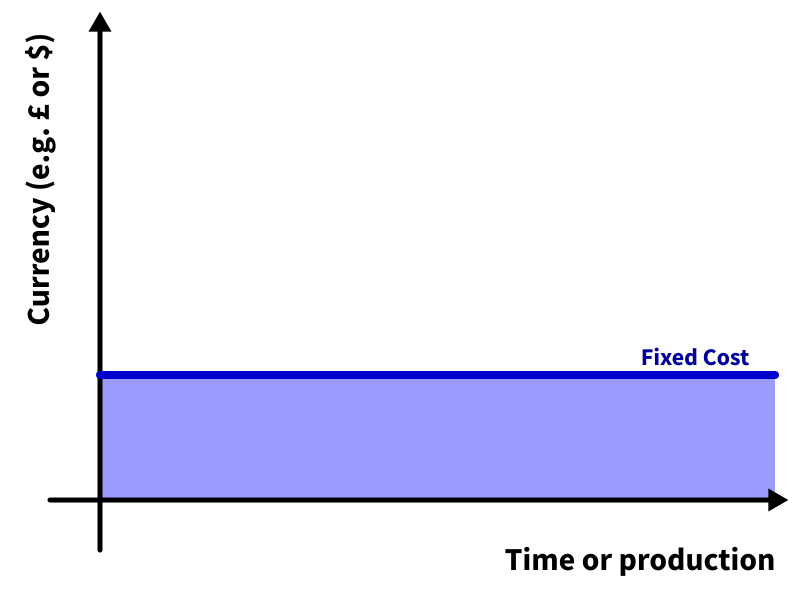
- Fixed costs are those that do not change with the level of production or sales. These costs are typically outlaid expenditures at the start of a project that do not, of themselves, generate an income, but without which the project cannot happen.
- Variable costs
- Variable costs are those that do change with the level of production or sales.
- Revenue
- Revenue is income, usually quoted in relation to the level of production or sales.
Consider these terms applied to, for example, a taxi. The purchase of the car is a fixed cost. Without the car, no revenue can be generated, but the car itself is a cost and does not generate revenue. The fuel and maintenance are variable costs, as they vary with each mile driven. The revenue is the fare paid by the passenger, typically per mile traveled.
Very often, fixed costs, variable costs, and revenue are represented on a graph with time/production on the abscissa and currency value on the ordinate, as shown below:
Payback
The payback is a period of time or the amount of production required for the revenue to cover the fixed and variable costs. After the payback period, the project will start to generate a profit and be considered financially viable. Any time or production before the payback is reached will result in an overall loss for the project, and any time or production after the payback will result in an ongoing profit.
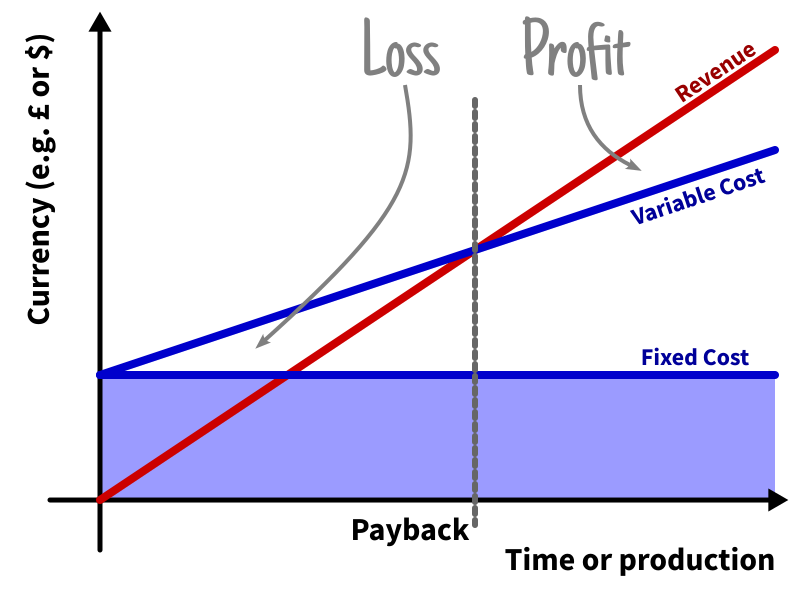
Consider the taxi example. Let's say the fixed cost to purchase the vehicle is £10,000 and the variable cost is £0.20 (20p) per mile. The taxi charges passengers £2.20 per mile. Each mile generates £2.00 of profit, so it would take 5,000 miles to recover the initial fixed cost of the vehicle. The payback period for this investment would be 5,000 miles.
Try this example
A chemical manufacturing firm is considering investing in a new reactor. The reactor will cost £650,000 to install. The raw material for the reactor costs £100 per tonne, and the energy costs to run the facility are £40 per tonne. The selling price of the product is £270 per tonne, and the engineers estimate the reactor can process 10 tonnes per day. Calculate the payback production and time for this potential investment.
What if the project doesn't generate revenue?
Some engineering projects may not necessarily generate a direct income. For example, installing solar panels on a factory could incur a significant capital expenditure and not generate additional income. They will, however, generate savings in energy costs. To analyze savings with the payback method, the savings can be treated as revenue, as they reduce operating costs and improve the overall financial performance of the business.
Things can be a little trickier when there are neither savings nor revenue generation. For example, an investment may be considered for the public good, such as a flood defense system. The proposal is adding value, but the financial value may be more difficult to determine. While it may seem morally challenging, to determine the viability of an investment, the financial value of the intervention needs to be quantified. The financial savings could be compared to the cost of doing nothing or to the savings achieved by other options. For example, a flood defense system could save financial losses from property damage, a public park could bring savings in healthcare and well-being costs, or an emergency warning system could reduce disaster response costs.
Economies of Scale
The term "economies of scale" implies that a project can be more financially effective by generating more production from a fixed cost. When applied in terms of payback, increasing the rate of production results in a faster payback time. Alternatively, a greater production rate could result in a smaller profit per unit to recover the fixed costs, which could make the product more affordable to the customer.
Working with Uncertainty
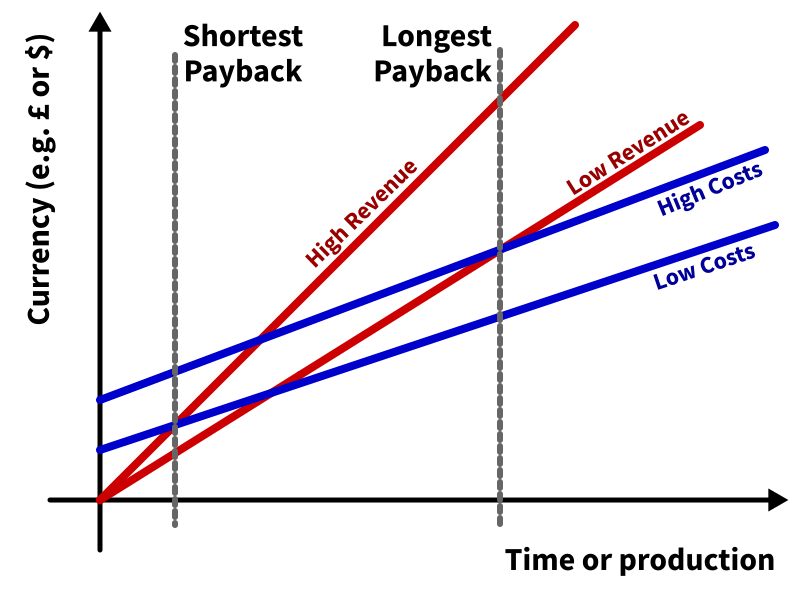
As with all financial predictions of the future, there will be uncertainty. One method to deal with uncertainty is to anticipate best and worst-case scenarios for cost and revenue and calculate a range of potential paybacks. A prediction based on an optimistic high revenue and low cost will have a short payback. The same project could have a contingency possibility of low revenue and high costs, resulting in a longer payback.
Assessing Paybacks
How do we know if the calculated payback represents a good or bad investment? You don't. The payback provides a quantification of the financial investment, and different investors may have different tolerances to risk and return. As a very broad indication of typical expectations, industry would look for a payback of 1 to 2 years, ideally less than 3. Investments with a payback of 10 years or more would generally not be considered viable. Personal or domestic investments tend to have a more relaxed threshold for the payback period, especially if the investments have more than just financial value. Domestic solar panels, for example, can have a payback of 10 years or more but are purchased for their environmental and ethical value.
Income and Expenditure
Related but differet concept are that of CAPEX and OPEX. CAPEX is the capital expenditure, the money spent on the purchase of assets. OPEX is the operational expenditure, the money spent on the day-to-day running of the project. These terms are similar to fixed and variable costs, but are more often used in the context of large industry. OPEX would typcially include time based costs such as salaries, rent, and utilities. CAPEX would include the purchase of machinery, buildings, and other assets. CAPEX, OPEX and income can be used to determine the viablibilty/profiabilty of a business, where as fixed and variable costs are used to determine the viability of a project.